San Francisco FTTP analysis embraces economic reality
25 March 2016 by Steve Blum
, ,

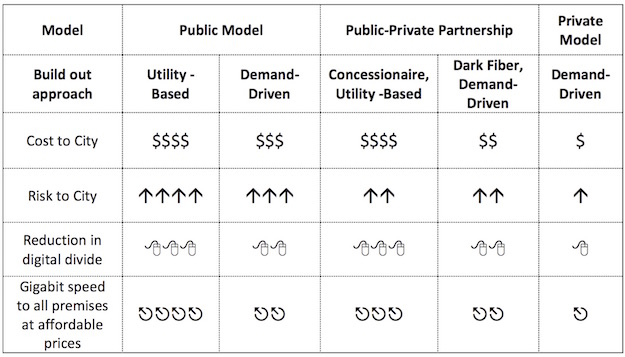
The fiber-to-the-premise analysis run by the City and County of San Francisco nailed it: providing gigabit capability to every home and business in the City means either treating it like a normal municipal utility and taxing everyone to pay for it – $43 a month, they figure – or taxing everyone less – $26 a month – and making up the rest with subscription fees from people that want to use it.

The everyone pays, everyone gets model means a big initial buildout for something close to a gigabuck, with the $43 monthly fees split between paying that off and running the system as a municipal utility.… More


AT&T writes its own permission slip to end California wireline service

23 March 2016 by Steve Blum
, , , , ,

Cheaper to chop than fix.

AT&T wants to rip out its copper phone networks in California and sell wireless voice and broadband service instead. Its lobbyists in Sacramento wrote a bill – assembly bill 2395 – that would give AT&T blanket permission to shut down regulated plain old telephone service and replace it with whatever kind of unregulated technology it deems most profitable.

For customers lucky enough to live in a high potential area – someplace dense enough with customers and cash to make wireline service sufficiently lucrative – that’ll mean voice over Internet protocol phone service running on one flavor or another of DSL broadband.… More

AT&T tries $100 million grab from California taxpayers

21 March 2016 by Steve Blum
, , , ,

AT&T wants to change California law so that it can take $100 million from taxpayers, for broadband service that’s considered unacceptable under state standards. Assembly bill 2130 was rewritten by AT&T lobbyists and re-introduced last week. It would 1. freeze the current California Advanced Services Fund (CASF) broadband infrastructure subsidy program, 2. authorise the collection of $100 million more from taxpayers, 3. distribute it according to byzantine rules that all but guarantee that the money would go to AT&T to spend as it pleases, while 4.… More

Frontier asks for CASF subsidy for Shasta County middle mile project

14 March 2016 by Steve Blum
, , ,


Right down the middle.

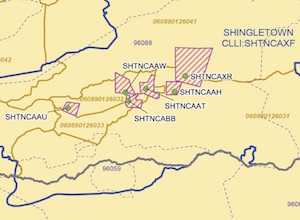
A grant application for a $546,000 subsidy from the California Advanced Services Fund was filed last week by Frontier Communications. It’s proposing to build a 12-mile fiber middle mile system in Shasta County, with the goal of injecting more bandwidth into existing DSL facilities that serve 1,200 homes in the Shingletown area…

These sites are currently fed with Ethernet over copper technology and the existing bandwidth is not capable of providing more than 3 Mbps download speeds and 768 Kbps upload speeds.

More

City of Gonzales approves simple dig once policy

A simple, one-page dig once/shadow conduit policy was adopted earlier this month by the Gonzales, California city council. The policy is a simple way to give public works staff the ability to include broadband conduit in road maintenance, utility digs and similar projects. It’s an adaptation of a staff-level policy that was implemented by the City of Salinas a few years ago, forming the basis for its recently launched commercial/industrial broadband network initiative.

Under the policy, the assumption is that conduit will be installed any time the city opens up a trench, subject to the public works director’s discretion…

Unless waived by the Public Works Director on the basis of undue burden, or an unfavorable cost-benefit analysis, or the consideration of other relevant factors, Gonzales will install or have installed communications conduit whenever the City undertakes or authorizes the following types of projects:

  1. New street, road, sidewalk, bike path, or other transportation infrastructure construction.
More

Google adopts Santa Cruz muni fiber model in Huntsville

29 February 2016 by Steve Blum
, , ,

The City of Huntsville, Alabama is following Santa Cruz’s fiber lead: building a fiber to the home (and business) network and leasing it out to a private operator. In Huntsville’s case the private operator is Google Fiber, while in Santa Cruz the partner is a local independent Internet service provider, Cruzio.

The lead consultants on the Huntsville project – CTC Technology and Energy – applied the lessons they learned working for the City of Santa Cruz

The partnership model announcement today between Huntsville and Google Fiber is on the model of that pioneered by Westminster, Maryland in 2014 and by Santa Cruz, California last year…

This innovative, shared-risk partnership model puts the locality in the business of building infrastructure, a business it knows well after a century of building roads, bridges, and utilities.

More

California broadband consortia try for second round of grants

23 February 2016 by Steve Blum
, ,


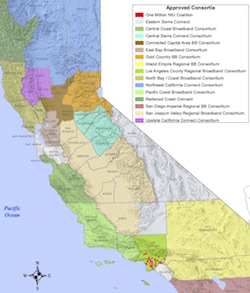
Click for the big picture.

Funding for the regional broadband consortia that the California Public Utilities Commission approved four years ago has either expired or soon will. For most, that’ll mean a gap in funding while proposals for new consortia grants are processed. A total of fifteen applications were filed by last month’s deadline.

The San Diego consortium did not reapply, but it’s been inactive for some time. The One Million New Internet Users consortium in Los Angeles County didn’t come back either, which is no surprise given the way it was ripped by a state audit.… More

Network ownership will no longer mean content control with new STB rules

16 February 2016 by Steve Blum
, , , ,

It’ll all look the same.

Opening up the currently closed set top box market will disrupt, and perhaps kill, the network business models that rely on it. On Thursday, the Federal Communications Commission is set to launch a process that to write new rules requiring cable, satellite and other flavors of multichannel video programming distributors (MVPDs) to give third party manufacturers direct access to their television transmission streams, including on-screen guide data. With all due respect for license limitations, such as recording rights, of course.… More

Gigabit competition upsets cozy pricing equilibrium

15 February 2016 by Steve Blum
, , , ,

It will come back up, eventually.

Big incumbents are cranking up the marketing volume on a gigabit services in urban areas with high revenue potential, but there’s very little, if any, gigabit-capable infrastructure actually deployed yet, except for Verizon’s FiOS systems. So pricing for some is still conceptual, and high, while others are already fighting it out on the ground.

Comcast is talking about charging $299 a month and a $1,000 installation fee for its 2 Gbps service.… More

Californian WISPs argue for exclusive right to offer poor service at a high price

12 February 2016 by Steve Blum
, , ,

True. Someone needs to think smarter.

A couple of fixed wireless operators are fighting a rear guard action against a fiber to the home project in Nevada City. Approved for a $16 million California Advanced Services Fund subsidy by the California Public Utilities Commission in December, the Bright Fiber project would bring FTTH service to about 2,000 homes in the Nevada City area. Smarter Broadband and ColfaxNet don’t like that: they’ve gotten used to selling slow and expensive service to people that don’t have a choice.… More