Big buck proposal for California broadband aims for wide appeal

4 February 2016 by Steve Blum
, , , ,

More money to build broadband infrastructure in California is back on the table, along with even more money for other broadband-related initiatives. Assembly bill 1758 was introduced at the state capitol by assemblyman Mark Stone (D – Santa Cruz) this week. It’s a new and improved and greatly enlarged version of last year’s effort to put more money in the California Advanced Services Fund, and raise the minimum broadband standards it supports.

AB 1758 would more than double the size of the fund, raising it from its current maximum of $315 million to an eventual $665 million.… More

Technology neutral does not mean price and service oblivious

3 February 2016 by Steve Blum
, , , ,

It was either pay the rent or the Verizon bill, but at least I’m getting good reception.

The Federal Communications Commission got it right last week, and the California Public Utilities Commission got it wrong. On the one hand, the FCC formally decided that “fixed and mobile broadband services are not functional substitutes for one another“, and reaffirmed that the minimum acceptable speed for wireline service is 25 Mbps down/3 Mbps up.… More

Mobile broadband can't take the place of wireline, FCC says

2 February 2016 by Steve Blum
, ,

Probably not doing his homework.

Mobile broadband service is not a substitute for in-home wireline service. That’s the headline conclusion from the Federal Communications Commission’s 2016 Broadband Progress Report. The report, approved on a semi-bipartisan 4 to 1 vote last week (republican Michael O’Rielly dissented), draws a hard distinction between wireline and mobile, in terms of speed, cost and functionality…

Consumers have advanced telecommunications capability only to the extent that they have access to both fixed and mobile broadband service.

More

Sorry Lee Vining, mobile is good enough for you

1 February 2016 by Steve Blum
, , , ,

No future here.

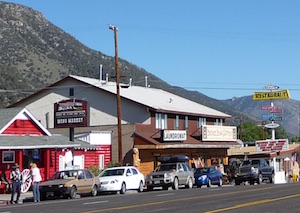
Fiber to the home service is coming to a string of small Mono County communities generally along U.S. highway 395 (and along the Digital 395 fiber backbone), but one – Lee Vining – will be left out.

The California Public Utilities Commission approved a $6.6 million grant to Race Telecommunications from the California Advanced Services Fund (CASF) to build out FTTH systems in South Chalfant, Benton, Benton Hot Springs, Swall Meadows and Mono City.… More

Wireless permit shot clock primer for Californian planners

29 January 2016 by Steve Blum
, , ,

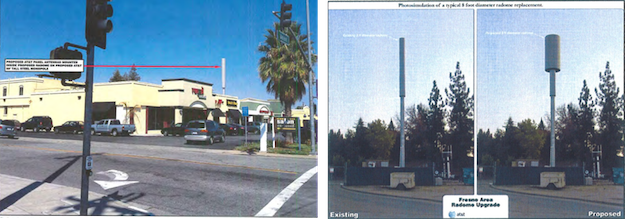
Sharp limits on local review of proposed cellular sites and other wireless facilities went into effect in California at the beginning of the year. It’s the result of a new law passed last year – assembly bill 57 – that put teeth into Federal Communications Commission shot clock rules that say cities and counties have to make a decision on permit applications within 90 days if it’s adding equipment to an existing site or 150 days if it’s completely new.… More

Salinas targets Ag Tech Corridor, downtown with broadband RFP


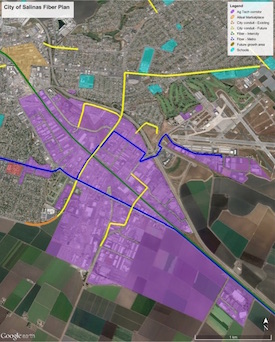
Click for the RFP.

The City of Salinas has officially released a request for proposal, looking for telecommunications companies that are interested in using its municipal conduit system and other local assets to build out a high speed broadband system in key commercial and industrial areas…

The City of Salinas owns a total of 16,000 feet of telecommunications conduit that is available for use (see above referenced study) by respondents. Approximately 5,400 feet is in the core downtown business district, 1,600 feet in or near the planned Agricultural Technology Corridor and another 9,000 feet in an unincorporated area southwest of the city.

More

EPA wants to send broadband experts to your town

25 January 2016 by Steve Blum
,


Top. Men.

The Environmental Protection Agency is the latest federal agency to jump into the broadband development game. Let’s get the bad news out of the way first: there’s no money on the table.

What the EPA is offering is “a team of experts [that] will help community members develop strategies and an action plan for using planned or existing broadband service to promote smart, sustainable community development”. In other words, if you are in a small rural town and have a broadband project in mind or, better yet, one that’s already funded, the EPA – working with the U.S.… More

Power to the people and back it up too

24 January 2016 by Steve Blum
, , ,

Consumer groups are asking the Federal Communications Commission to reconsider its new rule that requires telephone companies to sell back up batteries to customers when an outside power source is required. Companies should give subscribers batteries, the groups say.

The core issue is whether carriers will be required to pay for backup batteries at users’ homes to make sure that phone service remains available during a power outage. Old style phone service – copper – was self powered and remained operational during power failures.… More

Competition heats up for broadband subsidies in the Californian desert

22 January 2016 by Steve Blum
, , , ,

There’s a second bid for grant money to build a fiber to the home system in the San Bernardino County desert communities of Phelan, Piñon Hills, Oak Hills and West Cajon Valley, plus parts of Victorville and Hesperia. Yesterday, Ultimate Internet Access, Inc. (UIA) asked for a $21 million infrastructure subsidy from the California Advanced Services Fund CASF) for the project. It’s now competing directly with Race Telecommunications for the cash.

Last August, Race submitted a $48 million grant proposal, also for an FTTH build in that area.… More

People understand broadband, they just can't always afford it

20 January 2016 by Steve Blum
,

Any questions?

In the I’ve been meaning to write about this file is the Pew Research report released last month that showed a dip in fixed home Internet access and a corresponding blip in mobile-dependent households. Overall, the report says the national consumer broadband adoption rate is staying steady at about 80% of homes. But at the margins, where cost is critical, more people are putting smartphones ahead of wired (or, presumably, fixed wireless) service.

Cost is also the issue for people who have no broadband service at all.… More