Petrolia project shows how middle mile subsidies boost last mile speeds

21 June 2015 by Steve Blum
, ,

Click for more maps and financials.

Frontier Communications is asking the California Public Utilities Commission for $203,000 from the California Advanced Services Fund (CASF) to pay for 60% of the cost of upgrading a microwave link between the tiny and remote Humboldt County town of Petrolia and high capacity fiber backhaul to the north in Ferndale. The application made it through the review process, and is now scheduled to be voted on by the CPUC next month.


More

Low income subsidies for broadband service pushed by FCC

20 June 2015 by Steve Blum
, , ,

What would Ronald Reagan do?

The Federal Communications Commission voted 3 to 2 along party lines on Friday to begin work on a plan to extend lifeline benefits – telephone bill subsidies for low income people – to broadband service. We don’t exactly what they did, because the actual text of the decision won’t be available until commission staff get around to publishing it, but we do know that Ronald Reagan would have either loved or hated it.… More

FCC wastes no time in bringing the net neutrality hammer down hard on mobile carriers

19 June 2015 by Steve Blum
, , ,

Shoot the first one out the door. That’ll give them to know our intentions as serious.

The Federal Communications Commission took a hard swat at AT&T, fining it $100 million for trying to weasel out of unlimited data deals it offered back in the days when the iPhone was being launched…

We find that AT&T…apparently willfully and repeatedly violated the Commission’s Open Internet Transparency Rule by: (1) using the misleading and inaccurate term “unlimited” to label a data plan that was in fact subject to prolonged speed reductions after a customer used a set amount of data; and (2) failing to disclose the express speed reductions that it applied to “unlimited” data plan customers once they hit a specified data threshold.

More

CPUC offered opportunity to duck broadband responsibilities

18 June 2015 by Steve Blum
, , ,

The third way.

The California Public Utilities Commission has a third option for closing out the failed Comcast-Time Warner-Charter mega mash up. In response to a request from the companies involved, a CPUC administrative law judge has drafted yet another proposed decision that basically calls it all off, with a couple of housekeeping conditions.

Chief among those conditions is a requirement that the companies turn over digital copies of documents they previously provided to the Federal Communications Commission.… More

Frontier picks up a federal funding option but might miss even more in California

17 June 2015 by Steve Blum
, , ,


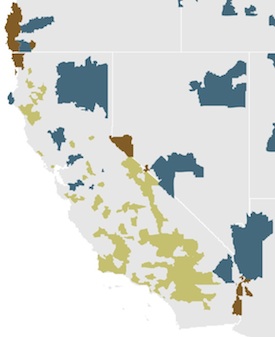
Frontier has claimed the blue and brown areas, but Verizon could leave the yellow areas behind. Click for a closer look.

Frontier Communications is the first of the larger U.S. telephone companies to take up the Federal Communications Commission’s offer of several years of subsidies in exchange for upgrading broadband infrastructure in rural areas to a minimum service level of 10 Mbps download and 1 Mbps upload speeds.

The FCC announced yesterday that Frontier had said yes to its right of first refusal on money from the second phase of the Connect America Fund program.… More

Mobile carriers detail plans for adding unlicensed spectrum to their portfolios

16 June 2015 by Steve Blum
, , ,

Kind of like parking one of these in a yacht harbor. But it’s OK. They’ll be careful.

With the rate of growth – let alone growth itself – in mobile data usage continuing to boom, with no end in sight, mobile carriers are searching for new spectrum. First choice is licensed, exclusive frequencies of course, but there’s no reason for them not to grab for their second choice too, which is unlicensed spectrum.

The Federal Communications Commission has been taking comments on the possibility of mobile carriers operating alongside WiFi in the unlicensed bands.… More

U.S. military share its spectrum with the public for wireless broadband use

15 June 2015 by Steve Blum
, , ,

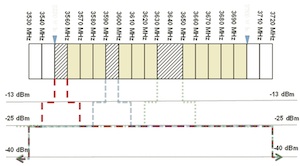
The U.S. defense department is giving up its sole control 100 MHz of prime spectrum – 3550-3650 MHz – which is adjacent to 50 MHz – 3650-3700 MHz – that’s already available for semi-licensed use, and the Federal Communications Commission is combining it all into a new citizens broadband radio service that will share the space with existing users. An automated spectrum access system (SAS) will coordinate use by three different classes of users with different levels of privileges.… More

Tizen chases the IoT dream with a less is more approach

13 June 2015 by Steve Blum
, , , ,

Or maybe just the future of washing machines.

The Tizen operating system is at the center of Samsung’s Internet of things strategy, according to a company blog post. Backed by Intel and others as well as Samsung and originally intended to be an alternative to Android in the mobile phone space, Tizen’s focus appears to have shifted to embedded systems…

Tizen requires less processing power and memory, thereby ensuring faster device speeds while consuming less energy…

Because it is lightweight, Tizen is optimal for use across a wide spectrum of smart connected devices in the IoT space.

More

Internet service providers are common carriers, beginning today

12 June 2015 by Steve Blum
, , ,

No blood, no foul, no stay.

The Federal Communications Commission’s common carrier rules for broadband infrastructure and service take effect today. Yesterday, a three-judge federal appellate court panel denied a request by telecoms companies to put the rules on hold while the appeals process moves forward. The judges didn’t give a specific reason, simply saying “petitioners have not satisfied the stringent requirements for a stay pending court review”.

However, the ruling did cite a U.S.More

Charter bid to buy Time Warner could widen California's digital divide

11 June 2015 by Steve Blum
, , , ,

If Charter Communications is successful in its attempt to buy Time Warner Cable and Bright House Communications, it will control about half of the Californian broadband market, and low income households will make up a disproportionately high share of that expanded customer base.

Comcast’s failed attempt to buy Time Warner (including Time Warner’s ownership interest in Bright House) and swap markets with Charter would have given it control of 84% of the broadband market in California, according to an analysis done by the California Public Utilities Commission’s office of ratepayer advocates (ORA).… More