CPUC reform proposal increases transparency and avoids drag

29 June 2016 by Steve Blum
, ,

The long list of reforms planned for the California Public Utilities Commission by governor Jerry Brown and a trio of lawmakers will make proceedings more transparent and open to public participation, and appears to moderate some of the procedural sand that current proposals would throw into the gears. Well meaning sand, but sand nonetheless.

The package announced on Monday rolls in bills that Bay Area senators Jerry Hill and Mark Leno have already put on the table.… More


Governor, legislators agree on sweeping CPUC reform package

28 June 2016 by Steve Blum
, ,

A plan for a major overhaul of the California Public Utilities Commission was announced yesterday by governor Jerry Brown and three legislators – Bay Area senators Mark Leno and Jerry Hill, and LA assemblyman Mike Gatto – who have been pushing for significant changes, even to the point of getting rid of it altogether (h/t to Regina Costa at TURN for the heads up).

The first item on the long list is to get the CPUC out of the business of policing some transportation services, most notably ride sharing companies like Uber and Lyft, but also certain bus companies and other land and water conveyances.… More

California conduit battle continues as AT&T dances around the question

24 June 2016 by Steve Blum
, , , ,

Webpass’ fight with AT&T over access to conduit continues. That’s the word from a Kind Reader of this humble blog who seems to be in a position to know. Yesterday’s post about the complaint Webpass has filed with the California Public Utilities Commission about AT&T’s conduit access practices was behind events on a couple of points. I didn’t know the outcome of last week’s hearing or the fact that Google Fiber bought Webpass on Wednesday.… More

Webpass challenges AT&T's iron grip on conduit

23 June 2016 by Steve Blum
, , , ,


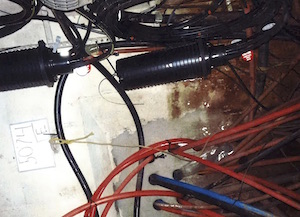
Splice case in AT&T manhole, click for the big picture.

Update: Webpass was just acquired by Google Fiber. That won’t have an immediate impact on the proceeding – lots of hoops to jump through first – but long term, it’ll be fun to watch. Stay tuned.

Telephone companies and other regulated utilities have to share conduit and pole access. They can charge each other a particular rate for it or, if usable space is lacking, require upgrades.… More

Bills to scrap local cell site review and California Public Utilities Commission delayed

22 June 2016 by Steve Blum
, , , ,

Don’t have to look far to find a horse in Sacramento.

Afternoon update: There’s a growing consensus that AB 2788 is dead, rather than just delayed. Resurrection is always possible while the legislature is in session, though. We’ll know its status for sure, at least its current status, by Monday, if not before.

A proposal to allow mobile carriers to install cell sites pretty much anywhere they want – including on publicly owned property – without meaningful review by local government has been bumped by a week.… More

Bill forcing California cities to lease cell sites, scrap permits magically appears

20 June 2016 by Steve Blum
, , ,

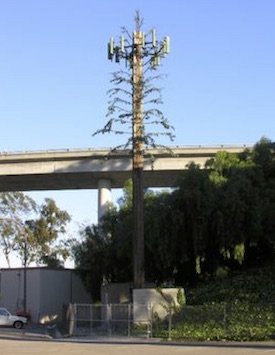
Camouflaged with associated equipment. Can’t get any smaller than that.

Using a legislative maneuver delicately referred to as gut and amend, assemblyman Mike Gatto (D – Los Angeles) transmogrified a bill about natural gas storage into a free pass for mobile phone companies to 1. install cell sites pretty much anywhere they want with little or no oversight by local governments and 2. force local governments to lease publicly owned facilities for the purpose (h/t to Omary Masry at the City and County of San Francisco for the pointer).… More

Big okay for California dig once bill

16 June 2016 by Steve Blum
, , ,

Broadband infrastructure.

In a unanimous vote on Tuesday, the California senate’s transportation and housing committee approved assembly bill 1549, a proposal carried by north coast assemblyman Jim Wood. I was among those at the hearing and prepared to speak on its behalf, but we took our cue from committee chair Jim Beall (D – Silicon Valley) who, in polite words, hinted there’s no opposition, we’re all in favor, so make it quick. So we did.… More

Broadband is a common carrier service, says federal appeals court

15 June 2016 by Steve Blum
, ,

It’s all about customer perception.

Call it two and a half out of three. That was the vote by a panel of federal appeals court judges as they tossed out challenges by a wide range of Internet service providers, and ruled that the Federal Communications Commission acted legally when it said broadband is a telecommunications service, rather than an information service, and imposed common carrier regulations on broadband service last year.

Two judges were completely in favor of the new rules, and the third agreed with some of their reasoning but dissented on other points.… More

Mobile broadband doesn't perform as advertised, CPUC tells FCC

13 June 2016 by Steve Blum
, ,


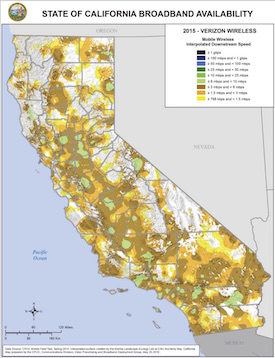
Click for the big, ugly picture.

Don’t believe the broadband speed levels that mobile carriers – AT&T, Sprint, T-Mobile and Verizon – claim to deliver. That’s what the California Public Utilities Commission is telling its counterpart in Washington, the Federal Communications Commission. Unlike the FCC, the CPUC has a rigorous, longstanding mobile data testing program that includes analysis based on what an actual customer would experience.

If you take Verizon at its word, for example, 99.6% of Californian homes would be getting mobile broadband service at the CPUC’s minimum 6 Mbps download and 1.5 Mbps upload speeds.… More

Four good reasons to favor FTTH over wireless broadband, CPUC says

2 June 2016 by Steve Blum
, , ,

No less deserving.

When it approved a $16 million grant for the Bright Fiber fiber-to-the-home project in Nevada County last year, the California Public Utilities Commission said that expensive and patchy wireless Internet service is not sufficient to block broadband infrastructure construction subsidies in underserved areas. Last week, the CPUC reaffirmed that decision, unanimously rejecting requests for a rehearing from two fixed wireless Internet service operators.

In doing so, the commission said that there are clear differences between wireless and wireline broadband service

  • First, the fiber-to-the-premises network proposed by Bright Fiber is not subject to terrain variability, and Bright Fiber has committed to serve every household in the project area…
  • Second, fiber-to-the-premise systems have significant speed advantages over fixed wireless systems…
  • Third, a fiber network has a significant advantage in terms of capacity over fixed wireless in any given area.
More