ViaSat bid for California broadband subsidies rejected
14 September 2015 by Steve Blum
, , , ,

There’s a difference between ambition and greed.

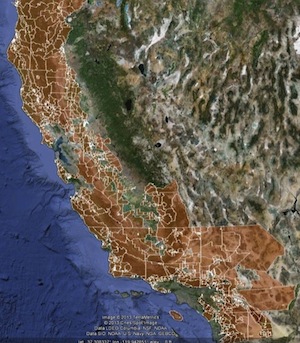
Nearly three years after it was first submitted, ViaSat’s proposal to deliver broadband service to a stunningly large swath of western and southern California is officially dead. The company had asked the California Public Utilities Commission for $11.1 million to buy satellite dishes and receivers for people living in underserved areas from the Oregon border, south along the coast and the western side of the central valley, to the Mexican border, and east to Arizona.… More
Google Fiber adds two California cities to the prospect list

13 September 2015 by Steve Blum
, , ,


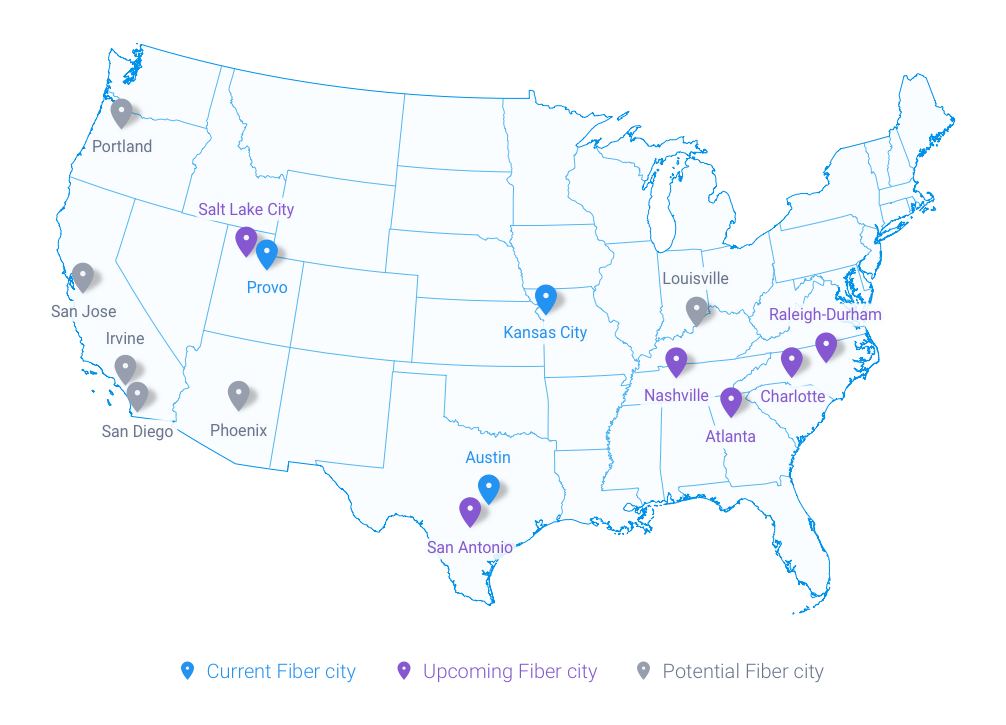
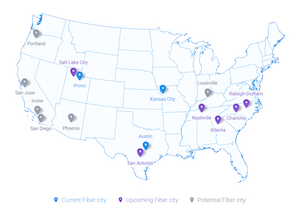
Click for a larger version.

Irvine and San Diego join San Jose (and surrounding Silicon Valley communities) as possible expansion targets for Google Fiber. The announcement, which was made in a blog post, also included Louisville, Kentucky.

All three are now “potential fiber cities”, which means that Google Fiber intends to talk with local officials about what’s needed to move it up the classification list to “upcoming fiber city”…

Our next step is to begin a joint planning process with city leaders, just as we did when we began working with nine metro areas last year.

More

Fiber middle mile link proposed for small California mountain community

12 September 2015 by Steve Blum
, , , ,


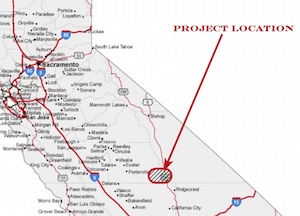
Click for the big picture.

The tiny eastern California community of Kennedy Meadows could be in line for a broadband capacity upgrade. The Ducor Telephone Company is asking the California Public Utilities Commission for $1.6 million from the California Advanced Services Fund (CASF) to build a fiber line from Kennedy Meadows to the Digital 395 route that runs along the eastern side of the Sierra, between Reno and Barstow.

According to the publicly available summary, Ducor’s microwave link has hit capacity and there’s no practical way to improve it…

Currently, network facilities serving the region cannot deliver acceptable levels of broadband service.

More

California-style regulation can kill or cure broadband, study says

10 September 2015 by Steve Blum
, ,

Reducing regulatory complexity, uncertainty and reach is the key to improving California’s broadband infrastructure, according to a report published by the Bay Area Council Economic Institute. The study assessed the telecommunications and energy infrastructure necessary to successfully competing in a 21st century economy, and the steps needed to get it.

The focus of the telecoms recommendations was regulation, both at the local planning and permitting level and by the California Public Utilities Commission. Environmental regulations were singled out as a particular barrier…

The California Environmental Quality Act (CEQA) is considered another cost and delay factor in any infrastructure development that involves trenching or surface disturbance.

More

Los Angeles opts for gigabit via unicorn to the home

9 September 2015 by Steve Blum
, ,

The City of Los Angeles took the next step toward creating a city-wide, gigabit capable broadband system by issuing a request for proposal, aimed at attracting bids from companies or, presumably, other types of organisations that want to build and operate it.

Earlier this year, Steve Reneker, the city’s general manager of information technology, asked “are we creating a unicorn here?” The answer is unequivocally yes.

The RFP can be summed up as pay us for permission to build a city-wide gigabit network and then give service away for free.… More

Rural means something different in California

8 September 2015 by Steve Blum
, , ,

California has been shut out of federal broadband grants for infrastructure projects in rural areas for the past several years. I was asked why don’t California’s wineries and farms throw lobbying dollars at the problem?

The wineries and farms don’t need to. California agriculture is characterised by large corporate holdings (albeit sometimes family controlled). The ag operations themselves can usually get sufficient connectivity, by building their own point to point microwave links and, occasionally, fiber connections.… More

Rapid growth in mobile data use puts pressure on everyone

5 September 2015 by Steve Blum
,


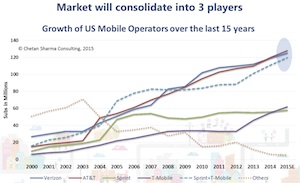
Click for the full presentation.

Mobile data consumption in the U.S. is growing exponentially, with typical usage hitting 2.5 GB per month, according to a report released by Chetan Sharma Consulting

The average mobile data consumption (cellular) is approximately 2.5GB/mo. In the US, it took roughly 20 years to reach the 1GB/user/mo mark. However, the second GB mark has been reached in less than 4 quarters. An entire year’s worth of mobile data traffic in 2007 is now reached in less than 75 hours.

More

Charter takeover of Time Warner would be anticompetitive, protests say

3 September 2015 by Steve Blum
, , ,

Maybe Comcast and Charter will get a junction named after them too.

Charter Communication’s bid to buy two rival cable companies, Time Warner and Bright House, appears headed down the same rhetorical highway that led to the death of Comcast’s similar attempt earlier this year. At least in California.

Three formal protests were filed against Charter’s request for approval of the deal from the California Public Utilities Commission, by the CPUC’s own office of ratepayer advocates (ORA) and various advocacy organisations.… More

CPUC endorses extending lifeline tax to broadband service

2 September 2015 by Steve Blum
, , ,

One of the ways that broadband service and infrastructure is subsidised is through universal service taxes paid by consumers on their telephone bills, both in California and at the federal level. Broadband itself, however, is not taxed in that way.

Earlier this year, the Federal Communications Commission decided that broadband is a telecommunications service that, to one extent or another, falls under common carrier rules and universal service obligations previously reserved for traditional telephone service. At the time, there was the usual partisan bickering over whether the FCC intended to use the new rules to extend universal service taxes to broadband.… More

Express lane bill for tower permits clears California legislature

1 September 2015 by Steve Blum
, , ,

Not much point if no one pays attention.

Permit applications for new cellular towers and other wireless telecoms facilities will be deemed granted in California, if local governments don’t make a decision within Federal Communications Commission deadlines. Assuming governor Jerry Brown agrees.

The California assembly waved assembly bill 57 through on a 66 to 8 vote last week, agreeing to amendments made in the state sentate. The measure puts teeth in the FCC’s shot clock: if an application for a new tower or other wireless facility isn’t approved or denied in 5 months or one for collocation of equipment on existing facilities isn’t acted upon within 3 months, then the permit is automatically granted.… More