Verizon won't sell all in California, appears to be clinging to juciest bits of its wireline networks


Clinging to California.

Competitive local exchange carriers (CLECs) are companies that lease wholesale facilities from incumbents – typically lines from a central office to subscriber locations – and add their own elements, often backhaul, upgraded DSL equipment and voice services. That means that the quality and price of the service CLECs provide partly depends on the condition of incumbent networks.

The lobbying group that represents CLECs in Sacramento – CalTel – is happy to see Verizon sell its wireline networks to Frontier Communications

CalTel considers Verizon California to be an often uncooperative and indifferent-at- best wholesale supplier.

More

Trans Sierra project proposes to bridge a mountain broadband gap

9 June 2015 by Steve Blum
, , , , ,


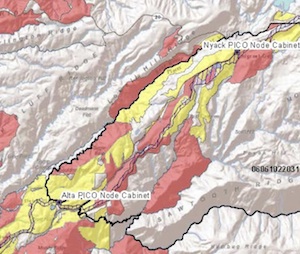
Click for all the maps.

Inyo Networks – one of the companies behind the Digital 395 network that serves the eastern side of the Sierra Nevada – is asking the California Public Utilities Commission for a $3.7 million subsidy to build access nodes along an existing fiber route that runs between Reno and Sacramento, more or less down the I-80 corridor, and includes a spur that connects the system to the Tahoe basin. The project was developed with considerable help from the Tahoe area’s broadband consortium.… More

Hearings set to investigate Verizon's copper networks, but that's not enough

8 June 2015 by Steve Blum
, , ,

But it’s coming over the road, not over the top.

The condition of Verizon’s copper networks will be assessed, at least to an extent, by the California Public Utilities Commission. That’ll happen whether or not commissioners go along with president Michael Picker’s plan to cancel a formal study of wireline service in California. Verizon needs permission to sell its wireline systems to Frontier Communications. To help it reach a decision, the CPUC is holding what looks to be a lot of public hearings all over the state, specifically asking local residents about the state of those networks

The assets to be transferred include, in addition to the customer accounts, the physical assets of Verizon California such as poles, wires, switches, trucks, central offices and the like…

The workshops will review the technical condition of the network in the areas adjacent to the [public participation hearing] locations in order to inform the parties and Commission about the operational status of the facilities to be migrated from Verizon to Frontier, and what steps may be necessary to satisfy the consumer benefit and public interest tests for approval of such transfers under the Public Utilities Code.

More

Net neutrality becomes just another congressional logjam

6 June 2015 by Steve Blum
, ,

The wrangling over the FCC’s decision to regulate broadband service and infrastructure under common carrier rules will be decided in court and not in congress. That’s according to an article in the National Journal (h/t to the Baller-Herbst list for the pointer).

Congressional republicans have been talking about rewriting the 1996 communications act – the basic federal law regulating electronic communications – for the past couple of years. There’s good reason to do that, given the way the growth of Internet-enabled services and information have revolutionised the way we live since it was passed.… More

Coalition of the unbelieving tells CPUC to get the facts about Verizon's copper

5 June 2015 by Steve Blum
, , ,


Click for more naked network porn.

Frontier Communications’ proposed purchase of Verizon’s wireline networks in California can’t be adequately evaluated without investigating the actual state of those networks. Particularly the rural copper plant that Verizon is allowing to rot on the poles. That’s the gist of an unusual joint plea to the California Public Utilities Commission by the CPUC’s own office of ratepayer advocates (ORA), a group of consumer lobbying groups and the primary telecoms union in the state, the Communications Workers of America.… More

FCC hedging its common carrier bet in negotiations with AT&T

4 June 2015 by Steve Blum
, , ,

Don’t worry, it’s not time to walk away. Yet.

AT&T’s bid to buy DirecTv and add nationwide direct broadband satellite television service to its portfolio is getting caught up in the same kind of debate about broadband access that sunk the Comcast – Time Warner – Charter mega deal. According to a Washington Post article by Brian Fung, AT&T is offering to make concessions in exchange for approval by the federal justice department and the Federal Communications Commission.… More

Digital 395 proposes Inyo County FTTH expansion

3 June 2015 by Steve Blum
, , , , ,


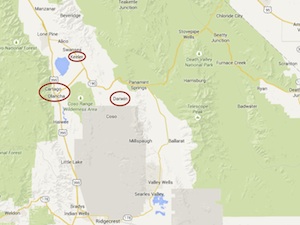
Click for a bigger version.

Four more remote towns in the eastern California desert are in line for gigabit-class fiber-to-the-home service, thanks to the Digital 395 middle mile network that stretches more than 500 miles down the east side of the Sierra Nevada, from Reno to Barstow.

Inyo Networks – one of the companies behind the Digital 395 project – is asking the California Public Utilities Commission for $4.4 million to extend its middle fiber another 20 miles, reaching from Olancha to Keeler and Darwin, and to build FTTH systems in those three communities, plus the nearby town of Cartago.… More

Limits on local authority over cell towers advance to the California senate

2 June 2015 by Steve Blum
, , ,

Cell towers and other wireless facilities are a matter of “statewide concern” and “not a municipal affair” according to California state assembly members. By a vote of 66 to 4, they approved assembly bill 57, authored by East Bay democrat Bill Quirk and sent it on to the state senate.

The core concept of the bill is that local governments shouldn’t be able to delay permits for building new towers or adding equipment to existing ones, beyond the limits set by the Federal Communications Commission.… More

Muni HFC broadband subsidy lands on Tacoma electric bills

1 June 2015 by Steve Blum
, ,

The meter is running.

Tacoma’s municipal electric system customers are paying more than three bucks a month to keep the city’s ageing broadband system running, whether they buy service from it or not. The municipal hybrid fiber cable TV system, which also supports Internet service, is reckoned to be losing $9.5 million year, according to a story by Kate Martin in the Tacoma News Tribune

[Tacoma Public Utilities] bosses have said that anything Click cannot pay will be borne by Tacoma Power customers, not all of whom can buy Click cable or Internet service.

More

Midwestern broadband experiments get most of the love from the FCC

29 May 2015 by Steve Blum
,

No mountains or trees to get in the way of the view. Or the broadband.

Six Internet service providers have been given the green light by the Federal Communications Commission to move ahead with a total of 15 projects in its rural broadband experiments program. All together, the projects will receive $12.6 million in subsidies over ten years to serve areas that lack 3 Mbps down/768 Kbps up service.

As with most federal broadband subsidy programs, the lions share of the money went to projects in the midwest.… More