Simplicity key to manufacturers’ home automation solutions

Cloud-based server checks to see how it's running. You can look inside yourself to see if you need milk.
Three competing, and perhaps ultimately complementary, home automation business models are emerging:
- Manufacturer supported.
- Consumer-centric.
- Carrier managed platform.
Lowes and AT&T moved aggressively at CES last week to position themselves as leaders in the consumer and service provider categories, respectively. Several companies were pitching to manufacturers, but the leader in that space looks to be Arrayent at this point.
The focus was on “it just works” simplicity for consumers. Manufacturers determine what kind of interactive features to offer customers and Arrayent provides the server-based support to make it possible.
Whirlpool is their marquee account. The refrigerator they had on display looked ordinary enough, but connected to Arrayent's infrastructure to provide a deliberately simple feature set of diagnostic and energy management support. Other manufacturers took notice.
“Once the news got out that Arrayent is the connected product platform, CPP, powering Whirlpool’s consumer appliance line, our booth was swarmed,” said Bob Dahlberg, vice president of business development at Arrayent. “Two memorable quotes of the week were ‘where have you been for two years?' and ‘we have been struggling to connect appliances for ten years, and with cloud connectivity we have half a chance to be successful'.”
With consumers providing the Internet connectivity – either directly via WiFi or with a wireless bridge in between – the cost to manufacturers of supporting products via the cloud is low. Whirlpool expects to more than offset the cost through warranty repair savings and the value of maintaining ongoing contact with consumers.
Big appliances are long term purchases, with expected lifetimes in the ten to twenty year range. Providing server-side support allows for at least some level of continuous functionality upgrades over that period, and builds a relationship with the brand that should pay dividends when products are eventually replaced.
Leaving CES, entering the future

Developers jump on a new mobile platform.
If mobile, desktop and other devices like TVs converge on a single operating system, it'll be a Linux variant. When processing, display and input technology get to the point that the size and form factor of a device is irrelevant, an open source ecosystem will provide a cross-sector point of convergence for developers and manufacturers. Service providers will follow. It's an entrepreneurs' world.
Windows 8 will survive as a mobile operating system. It'll have a place in enterprise networks, because its integration with desktop computing will appeal to some IT managers. It could even edge out RIM if the Blackberry 10 OS fails to impress. But I didn't talk to a single consumer facing app developer who is coding for anything other than Android and iOS.
Makers starting moving into CES this year. 3D printing grabbed everyone's attention, with printer manufacturers' booths jammed and a few garage scale start-ups showing products. Expect a lot more next year.
Wearable computing and home automation are closer to being commonplace. Near term, wristwatch-style Bluetooth devices like Pebble will provide quick text and incoming call notifications, plus limited control functions for your smart phone. Long term, eyeglass mounted video displays and health monitors will become self contained and fully functional, with or without a phone.
Retailers, manufacturers and service providers are jumping into home automation. Managed services, industry verticals, do-it-yourself kits and proprietary systems were in abundance at CES.
There's no clear leader in the space, but there might not need to be. Whether it's by automatically associating to a home WiFi network, talking to a networked hub or connecting directly to mobile networks, smart home devices will get their smarts from cloud-based middleware platforms. Consumers can just plug and forget. Apps and web pages will provide information and control.
It's fair to call the International CES a technology event rather than a dedicated consumer electronics show. Distinctions between consumer and enterprise markets, and shrink wrapped products and core technologies are largely irrelevant. Calling it global is still a stretch. Although attendees come from all over, only a quarter of the world's countries were represented on the exhibit floor. Two continents – Africa and South America – were all but absent. India's presence barely registered. Big as this year's show was, there's room to grow in 2014.
Home automation winners at Showstoppers

A joule of an idea.
The essence of genius is turning complex and confusing concepts into elegant simplicity. The Energy Joule manages the trick of taking your home's energy usage, benchmarking it against often byzantine electric utility rate pricing and distilling the result down to a simple glowing light.
Ambient Devices sells it to electric utilities, who in turn provide it to their customers. The idea is to give instant, easy to understand information about what it's costing to keep the lights and everything else on, so consumers can keep their bills down and utilities can spread out their load.
It connects to a smart electric meter at a consumer's home via a ZigBee radio, and reads both electric usage and the rate information that the utility pushes out. The Energy Joule then calculates cost. If it's high at the moment, it glows red. If it's in the economical zone, it turns green.
Other home automation and information devices on display at the Showstoppers press event at CES tonight included a smart oven and a networked video monitor.
Samsung has partnered with iWatchLife to offer realtime analysis of video streamed from a WiFi enabled camera. For $5 a month, the service monitors the feed from as many cameras as you want to install and looks for anomalies. When it spots something odd, it notifies you and starts recording. It has a five second buffer so you can see what triggered its interest.
Dacor has a programmable oven with what amounts to a built in Android tablet. It links via WiFi to your home Internet connection, and then on to a server. You can program in cooking instructions or just tell it what you're trying to cook and how much of it, and it'll do the rest. It comes with Android and iOS apps that also talk to the server and can remotely monitor and control the oven. It doesn't talk directly to the apps, though. No Internet connection, no remote control.
Lowes executes a home automation play

Presumptive retailing.
“It's our fault – technology and business models – we just haven't gotten it right,” said Kevin Meagher, vice president and general manager for the smart home segment at Lowes. The problem isn't consumers, who readily accept automation. “It's in our cars and none of us would buy one without it. The hurdle is getting it into the home,” he said.
Meagher was speaking at the Parks Associates Connections Summit at CES this afternoon. He acknowledged that there are some cases where propriety connectivity technology is appropriate, but if the home automation market is going to take off, standards have to be open and products have to be interoperable.
That concept was unsettling to at least one big systems guy. “We're on a slippery slope,” said Scott Burnett, director, global consumer electronics industry at IBM. “I think Lowes is going to get a little bloody on this.”
Burnett's solution is to have a coordinating group – he suggested the Consumer Electronics Association – set standards and keep things tidy. He seemed annoyed that a retailer would presume to tell the rest of the industry what consumers want to buy.
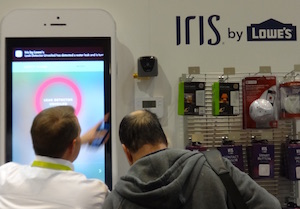
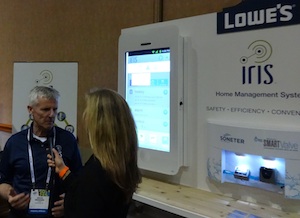
Lowes is showing their Iris home automation platform at CES. Their objective is to make it easy for consumers to mix, match, install and use any brand of connected home device. This heterogeneous ecosystem is managed by an Iris gateway that connects back to Lowe's servers, which do the heavy lifting on the management side.
The service is free. Or at least Lowes isn't charging money for it. Meagher says the value to Lowes is, first, in the ongoing relationship they build with the customer and, second, in the opportunity to make use of his or her data.
Meagher thinks consumers will accept it if Lowes delivers value in return. Which is the piece of the puzzle that the manufacturers and service providers are missing. “What they need is guys like us to execute for them.”
Home automation and wearable computing hits at Pepcom
The FitBit is the bit that fits inside the wristband.
Along with Alabama, Pepcom was a winner tonight. The second of the three major press group gropes at CES, it featured a tailgate party theme and the Notre Dame/Alabama game on big screens. Nearly 200 companies set up small displays at the MGM Grand, showing new products and new brand positioning.
Nexia was in the latter category. It's a re-branding of the Schlage Link home automation system. By establishing an independent brand identity, it can better position itself as a home automation platform for any Z-Wave compliant product.
Other home automation plays included…
- Arrayent, a middleware company that's protocol agnostic and works directly for manufacturers, who then set up whatever relationship they want with consumers. More about them later.
- Whirlpool, which is taking a well-considered step backward and focusing on networking appliances for truly useful reasons, rather than just slapping stuff onto refrigerators and washing machines.
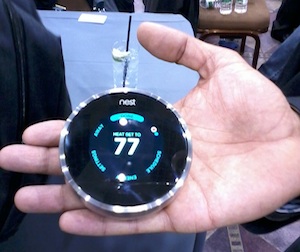
- Nest, which makes a thermostat that connects via WiFi to a server and watches what you do. The end result, they say, is that it learns your habits and adapts accordingly, eliminating the need for consumers to program it.
There were some interesting wearable computing products. Fitbit is an accelerometer that snaps into a nice enough looking wristband and monitors your fitness activities over the course of the day.
Basis was showing a wrist device that monitors your daily activity too, as well as your heart rate, perspiration and skin temperature, and gives you a health assessment via an app or web portal. And Martian Watch is a cool accessory to your smart phone. It sits on your wrist and lets you give voice commands and receive text messages via Bluetooth.
Three things you won’t see at CES 2013
Rocking with Jonney.
No computer companies. Ten years ago, they were the stars of the show. The final keynote by Microsoft’s Steve Ballmer last year marked the end of their run. (Apple was so far ahead of the curve they stopped showing up before they stopped being a computer company).
I’ll miss ASUS’s Jonney Shih and even Intel’s Paul Otellini. They had interesting ideas to share, and said it well. On the other hand, some won’t be missed. Ballmer’s snarling product demonstrations and Cisco CEO John Chambers’ autistic self promotion performances were embarrassing to sit through.
Second, consumer friendly home automation products and systems won’t appear. I hope I’m wrong. I had such great hopes for it last year, thinking at the time that service providers like mobile telecoms companies and cable operators would finally muscle into the business. Not so. It’s still a fragmented sector crammed with incompatible and, frequently, incomprehensible products.
The third thing you won’t see at the Consumer Electronics Show is, well, a consumer electronics show. Or so the Consumer Electronics Association, the organizers, are telling us…
Note to Editors: The official name of the global technology event is “International CES.” Subsequent references to the show can be shortened to “CES.” Please do not use “Consumer Electronics Show” to refer to the International CES.
I don’t know when this name change happened. It might have been a while ago and it didn’t register – some things tend to get caught in my mental spam filter. Particularly when it has corporate brain trust written all over it.
To be fair, it makes a certain amount of sense for CES. With specialized consumer electronics retailers dying out, the show is less and less about filling distribution channels and increasingly about showcasing products, of any kind, in order to drive demand directly.
On with the show.
Oh, you mean a Maxwell Smart home
“Chaos is an opportunity for people like me,” said Tom Kadlec, one of the founders of The Homeworks Group. They do the hard work of integrating and managing home automation systems for about a thousand subscribers. Both he and his partner have electrical engineering degrees, which is great for them but not so good for the home handyman who majored in, say, political science.

Protocol agnostic and easy to use: home automation needs heavy helpings of both if it’s to ever find its secret sauce. And the industry doesn’t seem to be much closer to solving it than it was a year ago. The missing piece is still a universal, consumer friendly gateway/hub device that can tie together different products using different protocols.
Last Thursday evening, the Wireless Communications Alliance rolled a discussion about home automation into its annual holiday party. Hosted by Qualcomm, the event featured four experts from different corners of the industry: two semiconductor makers, a market intelligence analyst and a custom installer.
“Our industry is based on a promise to solve all the problems,” IDC‘s Michael Palma admitted. “A lot depends on the service providers.” Gianluca Viale, from Renesas, offered patience rather than a solution, saying whatever it is, the silicon will still be there to support it whenever it happens.
Fabrice Hoerner, senior manager of technical marketing at Qualcomm, said they’re working on combining “multiple smarts:” smart connectivity, smart gateways, smart devices and a smart cloud.
“Everyone is building their own gateway, but there is an opportunity to bring some of them together,” Hoerner said. “If there is money to make, the industry will adjust to this potential.”
Maybe. But so far, home automation chaos has eighty-sixed home control.
No mass market home automation players yet
Incremental advancement but no break through into the mass market for the home automation sector at CES this year. It remains a niche for hobbyists and specialty contractors.
Core technology companies, such as Qualcomm, NXP and Marvell, continue to support it. And there’s no shortage of companies offering, or at least developing, home automation products and services.
Part of the problem is the multitude of standards. Some device makers support more than one, but interoperability is the exception rather than the rule.
The missing piece is a home hub/gateway that’s both consumer friendly and network protocol agnostic.
You can find one or the other. For example, MiOS’s Vera router handles WiFi, Ethernet and Z-Wave natively, and can manage X10 and potententially other protocols via plug-ins. But its user interface is balky and basic. You need to be confortable with programming code to do anything ambitious.
Jakks Pacific’s baby monitor product is easy to use, and the wrist watch-style viewing screen is a nice innovation. But it’s a one trick pony. Canadian company 2D2C’s SafePlug is an interesting RFID-enabled solution, but they only have one item in their product line ready for market. Spain’s q1tecno is targeting the low cost end of the market with their Domotics Toys.
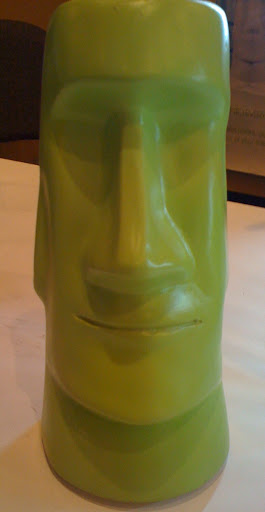
Home Protect, from France-based Moai, is a wonderfull piece of design work. They put their gateway and remote sensors into Tiki God cases that they claim will be plug-and-play simple to install. Unfortunately, it’s not ready for market yet. All they had to display at the show were solid plastic Tiki God statues.
Companies like Greenwave and Dutch manufacturer Freelux are positioning themselves as OEM suppliers to utilities. The advantage to that approach is that the electric company can provide customer support and incentives to use it. If the incentives are good enough, they can also dictate technology and network protocol choices to their subscribers. No one had any utility partnerships to announce, though.
Unnatural opportunity in M2M
Consumer electronics products have a natural limit to growth. With only 7 billion or so people on the planet, even if some people buy more than one of any gizmo you can’t get past, say, 10 billion deployed units within the life cycle of any given product category.
Of course, that’s a theoretical limit, as a practical matter even one billion is wildly out of reach for the vast majority of products. The mobile phone has hit the 6 billion range, because it’s a personal item rather than a family purchase, such as, for example, a television.
There’s no such natural limit in the M2M (machine to machine) telecommunications space, though. There are billions of machines that will have need to communicate with each other in the future, and each of those machines have internal components that might need to swap data too. That puts M2M’s market potential in the tens of billions in the coming decade alone. According to Ericsson CEO Hans Vespberg, it’ll be north of 40 billion by 2020.
That’s why early stage, core M2M technology companies are interesting to track. RFaxis is one such. Founded in 2008 with friends and family financing, this fabless semiconductor start-up makes front end chips for WiFi and ZigBee (and similar) radios.
Their secret sauce is a pure CMOS, single chip integrated front solution that combines antenna switching, power amplification on the transmit side, low noise amplification on the receive side and an interface with the transmit/receive module. RFaxis has attracted customers such as Gemtek, NXP and Freescale.
ZigBee-based smart meters are one of the segments that they see as having breakout potential for consumer-side M2M products. The opportunity begins with the smart meters themselves, but will quickly balloon once connected products, such as thermostats and energy consumption monitors, gain the backing of utility companies.
RFaxis currently has 27 employees and had revenue in the $2 to $3 million range last year. In 2012, they’re expecting to hit the $15 to $20 million range, which will, they think, make the venture self- supporting. Beyond that, there’s no natural limit.
Personal automation hits and misses
Among the dozens of companies showing their stuff at CES Unveiled tonight were several targeting the personal and home automation space. Some get it, some don’t.